
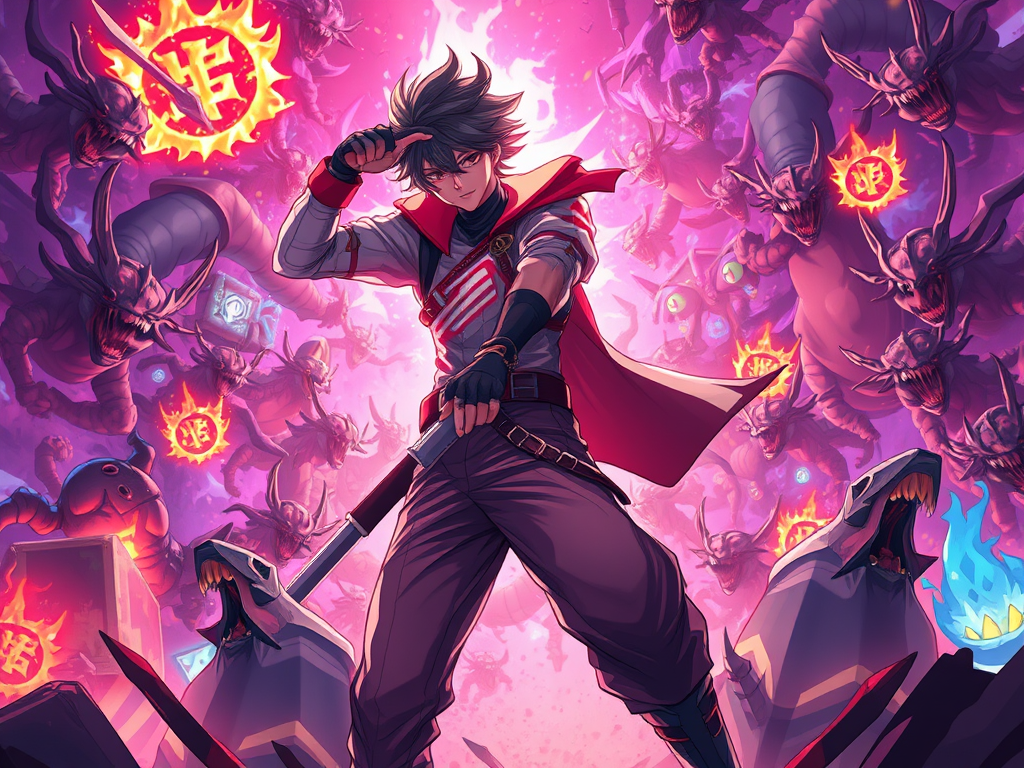
In the landscape of modern anime, Solo Leveling is far more than a high-budget spectacle; it is a cultural artifact of the 2020s. While critics often dismiss it as a repetitive “power fantasy,” its meteoric rise reveals a profound truth about our collective psyche. We aren’t just watching Sung Jin-Woo level up; we are participating in a narrative that perfectly encapsulates the dual nature of 21st-century life: the Dopamine Trap of digital gratification and the Shadow of the Grind within a hyper-competitive, neoliberal world.
. The Dopamine Trap: Engineering the “Perfect” Binge
In the modern attention economy, Solo Leveling is the ultimate predator. It doesn’t just tell a story; it manages the viewer’s brain chemistry with the precision of a Silicon Valley algorithm.
- The Gamified Narrative: Traditional storytelling usually relies on “Emotional Beats”—growth through loss, romance, or moral dilemmas. Solo Leveling boldly replaces these with “Numerical Beats.” When Jin-Woo’s Strength stat jumps from 10 to 50, the audience feels a visceral, lizard-brain sense of progress. This is the same psychological trigger used by “Gacha” games and fitness trackers. We are conditioned to love seeing numbers go up because it provides a clear, objective sense of “winning” that real life—with its messy, unquantifiable hurdles—rarely offers.
- The Erasure of Friction: Modern audiences are socialized for “skipping the intro” and “2x speed” consumption. Solo Leveling’s pacing respects this digital impatience. It effectively eliminates the “training arc” tedium by making the training itself part of the high-stakes action. Every push-up is a quest; every monster is a loot box. By turning the narrative into a series of constant payouts, the show eliminates “narrative friction,” making it nearly impossible to stop watching. It is the “TikTok-ification” of the epic journey.
2. The Shadow of the Grind: A Satire of “Hell Joseon”
While the “System” looks like a fantasy mechanic, for many, it feels like an average Tuesday morning. The show acts as a stylized exaggeration of the “Quantified Self”—the modern obsession with tracking every step, calorie, and productive hour to prove our worth.
- Social Mobility as Survival: In South Korea, where the story originated, the term “Hell Joseon” describes a society where the pressure to be an “S-Rank” student or employee is crushing. Jin-Woo starts as the “Weakest Hunter of All Mankind”—the ultimate social underdog. His transformation isn’t just about magic; it’s about brute-force social mobility. He is “grinding” his way out of poverty and insignificance in a world that literally ranks humans by their economic and physical utility.
- The Penalty of Non-Productivity: The “Penalty Quest” is perhaps the show’s most chilling metaphor. When Jin-Woo fails to complete his daily workout, he is transported to a desert to be hunted by monsters. This is the ultimate symbol of modern hustle culture: the idea that if you aren’t constantly upskilling, “grinding,” and improving your resume, the world will not just ignore you—it will actively destroy you.
3. The Death of the Shonen Hero: From Compassion to Efficiency
This shift toward “Instant Gratification Culture” has fundamentally changed what we want from a hero. Older icons like Naruto or Luffy fought for friends and dreams; Jin-Woo fights for efficiency.
- The Lone Wolf Success: The original title, Only I Level Up, is a stark commentary on the death of collective action. In a neoliberal world, we are told that success is a solo journey. As Jin-Woo grows stronger, he becomes increasingly isolated, his eyes turning colder and his mercy waning. He stops being a “person” and starts being an “asset.”
- Aura as Social Currency: Finally, we have the “Aura Farming” aesthetic. In our Instagram/TikTok world, looking successful is often as important as being successful. The way the shadows flow around Jin-Woo and the neon-blue glow of his eyes are visual status symbols. The show prioritizes the “Spectacle of Competence.” We watch it because we want to inhabit a world where every move is efficient, every strike is calculated, and the rewards are guaranteed by the “System.”
Conclusion: The Mirror of the “System”
Solo Leveling is the defining anime of the “Instant Gratification” era because it celebrates the very things that exhaust us. It takes the stressful “daily grind” of modern life and gives it a glowing, powerful aesthetic. We love Jin-Woo not because he is a moral paragon, but because he represents the fantasy of actually winning a game that we are all forced to play. He is the man who looked at the “System” of the world and, instead of breaking it, became its master.
Leave a Reply