
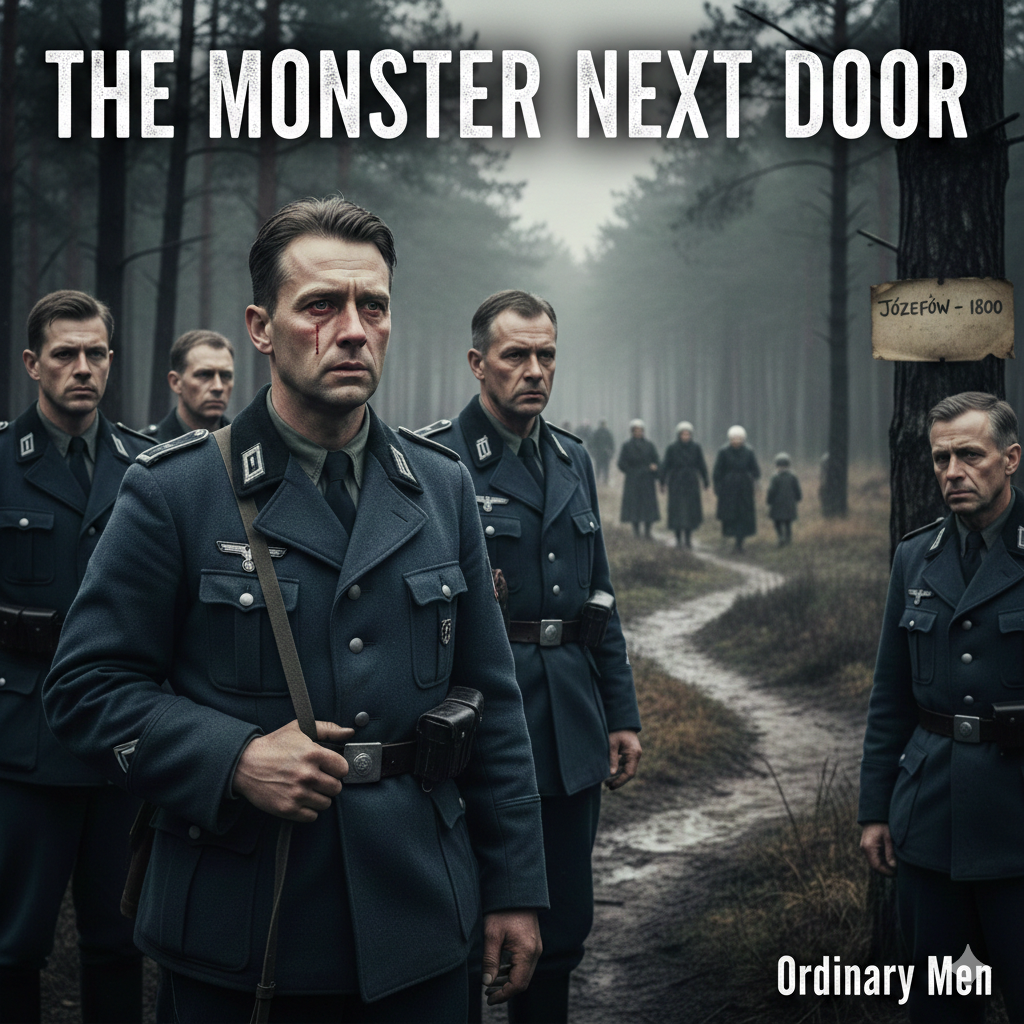
The year is 1942. The setting is the quiet, dusty village of Józefów in occupied Poland. A group of men, mostly in their 30s and 40s, climb out of transport trucks. These were not the black-shirted SS fanatics we recognize from cinema, nor were they elite commandos or brainwashed teenagers. Instead, they were “ordinary men”—dockworkers, truck drivers, and clerks from the city of Hamburg. Most were fathers. Many belonged to a pre-Nazi working class that had once stood in firm opposition to Hitler’s rhetoric.
Their commander, Major Wilhelm Trapp—affectionately called “Papa Trapp” by his subordinates—stepped forward with tears in his eyes. He had been handed a horrific order: his unit was to round up the village’s 1,800 Jews. The men of working age were to be sent to a labor camp; the women, children, and elderly were to be shot on the spot.
Then, Trapp performed a gesture nearly unprecedented in the history of the Third Reich. He offered his men a choice. He told them that if any man “did not feel up to” the task, he could step out and be assigned other duties without fear of reprisal.
In a battalion of nearly 500 men, how many do you think stepped out?
The answer is twelve.
This chilling moment serves as the cornerstone of Christopher Browning’s seminal work, Ordinary Men: Reserve Police Battalion 101 and the Final Solution in Poland. Decades after its publication, the book remains one of the most disturbing psychological profiles ever written. It doesn’t just document a massacre; it documents the terrifyingly short distance between a mundane civilian life and the heart of darkness.
Profile of a Killer: Who Was Reserve Police Battalion 101?
To grasp the weight of Browning’s research, we must first strip away the comforting myth of the “Nazi Monster.” We often shield ourselves from the reality of the Holocaust by believing its perpetrators were a specific breed of sadist or the products of lifelong brainwashing. Browning’s data forces us to confront a far more uncomfortable truth.
Demographics over Ideology
Reserve Police Battalion 101 was composed of men who were essentially “too old” for the front lines of the regular German army. These were men in their 30s and 40s who had grown up in the pre-Nazi era. Their formative years were spent in the social-democratic strongholds of Hamburg, not the indoctrination camps of the Hitler Youth. They were lower-middle-class individuals with families, mortgages, and deeply rooted civilian identities.
The Geography of Murder
Browning meticulously tracks the battalion across the bloody landscape of Poland. He identifies key milestones in their moral decay through the specific environments in which they operated:
- The Lodz Ghetto: This was the unit’s first exposure to the systematic starvation of the Jewish population. It provided the “visual training” necessary to stop seeing victims as human beings.
- Lozmazy: At this site, the killing became more “efficient.” The introduction of Hiwis (foreign auxiliary volunteers) created a layer of psychological distance. This allowed the German policemen to feel like “supervisors” of murder rather than hands-on executioners.
- The “Jew Hunts”: Perhaps the most haunting phase, these were operations where the battalion scoured forests for those who had escaped initial liquidations. In these hunts, the killings were no longer “ordered” in a formal line; they were sought out as a matter of routine.
The unit’s trajectory reached its crescendo during the “Harvest Festival” (Erntefest), one of the single largest German killing operations of the war. By this stage, the men who had once vomited at the sight of blood were operating with the cold, rhythmic efficiency of a factory line.
The Slippery Slope: From Revulsion to Indifference
A primary value of Ordinary Men is its documentation of the psychological progression of the killers. Browning identifies a three-stage descent into barbarism that serves as a universal warning for any society.
Phase 1: Initial Trauma
At Józefów, the men were visibly shaken. Browning’s research into post-war testimonies reveals men who missed their targets on purpose, men who wept, and a unit that required staggering amounts of alcohol to numb the experience. At this stage, the act of killing was still “unnatural” and physically repulsive.
Phase 2: Routine and Adaptation
As the battalion moved through places like Lozmazy, a sense of routine began to set in. The men developed “coping mechanisms.” They stopped viewing the victims as individuals and began to view the “job” as a logistical problem to be solved. By delegating the most visceral parts of the slaughter to auxiliary shooters, the policemen maintained a delusional sense of moral distance.
Phase 3: The “Jew Hunts” and Sadism
By the time the “Jew Hunts” began in the Polish countryside, the transformation was complete. What was once a source of nightmares had become a “hunt.” Browning notes that some men began to take pride in their “efficiency” and even showed signs of sadistic sport. The “ordinary man” had been recalibrated to view the slaughter of innocents as a standard professional duty.
The Why: Peer Pressure vs. Ideology
If these men weren’t all fanatical Nazis, why did they do it? This is the central problem of the text. Browning’s conclusion is both simple and devastating: they did it because they didn’t want to look weak in front of their peers.
The Myth of “No Choice”
A common defense in post-war trials was, “I was just following orders; I would have been killed if I disobeyed.”
Browning—supported by critics like Edward Alexander—effectively shatters this myth. Alexander points out that in over 45 years of post-war trials, not a single case has been documented where a German soldier was executed or severely punished for refusing to kill unarmed civilians. The choice was real. Major Trapp explicitly offered it.
The Social Trap: Conformity and Masculinity
The men who stayed in the ranks didn’t necessarily kill because they loved Hitler; they did it because they feared social exclusion.
- The “Dirty Work” Logic: By stepping out, a policeman was essentially saying to his comrades, “I am too sensitive for this, so you have to do my share of the killing.” In their eyes, refusal was not a moral act; it was an act of abandonment.
- The Masculinity Crisis: In the hyper-masculine, working-class culture of the 1940s, being labeled a “coward” was a social death sentence. For many, the fear of a cold shoulder from their friends was more terrifying than the act of murder.
Browning argues that the human desire to belong to a group is often a stronger motivator than abstract moral principles.
Critical Clash: Analyzing the Academic Debate
Ordinary Men is a masterpiece of historical research, but it has faced significant scrutiny. To understand the book’s legacy, we must examine the perspectives of other historians who challenged Browning’s “Ordinary” thesis.
Edward Alexander: The Ethics of Choice
Alexander provides a stern critique of Browning’s perceived “sympathy” for the men’s backgrounds. Browning suggested that these lower-class men might have lacked the “sophisticated abstract principles” to articulate a moral refusal. Alexander rejects this, arguing that moral agency does not require a high level of education. Everyone knows murder is wrong. He also notes a major omission: the lack of Jewish survivor testimony, which forces the reader to see the atrocities through the eyes of the perpetrators.
H.A. Turner: The Definition of “Ordinary”
H.A. Turner argues that Browning overuses the label “ordinary” to the point of being misleading. While the rank-and-file may have been average, they were led by career policemen and Nazi Party officers who were ideologically driven. Turner suggests that by focusing so much on “situational” factors, Browning downplays the specific culture of obedience that defined the Third Reich.
Martyn Housden: The Universal Warning
Housden is more supportive, arguing that the value of Browning’s research actually exceeds Browning’s own conclusions. For Housden, the book proves that a group without a firm “moral comprehension” can be led into genocide if the social conditions are manipulated correctly.
Modern Relevance: Is the “Ordinary Man” Still Among Us?
Why does a book about a 1942 police battalion remain a bestseller in 2026? Because the psychological machinery Browning describes is not a relic of the past; it is a permanent feature of human nature.
The “Digital Battalion”
In the digital age, we see the “Social Trap” playing out in online echo chambers. The fear of being “excluded” from one’s digital tribe often leads people to participate in dehumanizing behavior and “groupthink” that they would never engage in face-to-face.
The Milgram and Zimbardo Legacy
Browning’s work is the historical “twin” to Stanley Milgram’s experiments on obedience. Milgram famously showed that 65% of ordinary people would deliver a fatal electric shock to a stranger simply because an authority figure told them to. Browning shows us what happens when that authority figure is your friend, your commander, and your government.
Conclusion: The Burden of Individual Choice
Christopher Browning’s Ordinary Men is a mirror. It asks us to look past the uniforms and the historical distance to see the human face underneath—a face that looks remarkably like our own.
The most terrifying takeaway from the history of Reserve Police Battalion 101 is not that they were forced to kill. It is that they chose to kill because they were more afraid of being judged by their peers than they were of their own conscience.
History is a warning system. Browning reminds us that “civilization” is a thin veneer, and “ordinariness” is no shield against evil. The only true defense we have is the individual courage to be “weak” in the eyes of the group—the courage to step out when the Major gives the order.
A Final Thought:
If you were standing in the woods of Józefów, surrounded by your closest colleagues, and you were told that shooting was “the right thing for the team,” would you have been one of the twelve who stepped out? Or would you have been one of the 488 who stayed?
What do you think? Does “peer pressure” explain these atrocities, or does that explanation excuse the perpetrators? Share your thoughts in the comments below.
Bibliography
- Alexander, Edward. “Ordinary Men: Reserve Police Battalion 101 and the Final Solution in Poland.” Commentary (1993).
- Browning, Christopher R. Ordinary Men: Reserve Police Battalion 101 and the Final Solution in Poland. New York: HarperCollins, 1992.
- Housden, Martyn. “Ordinary Men: Reserve Police Battalion 101 and the Final Solution in Poland.” The Historical Journal (1994).
- Turner, H.A. “Ordinary Men: Reserve Police Battalion 101 and the Final Solution in Poland.” The Journal Of Modern History (1995).
Leave a Reply