
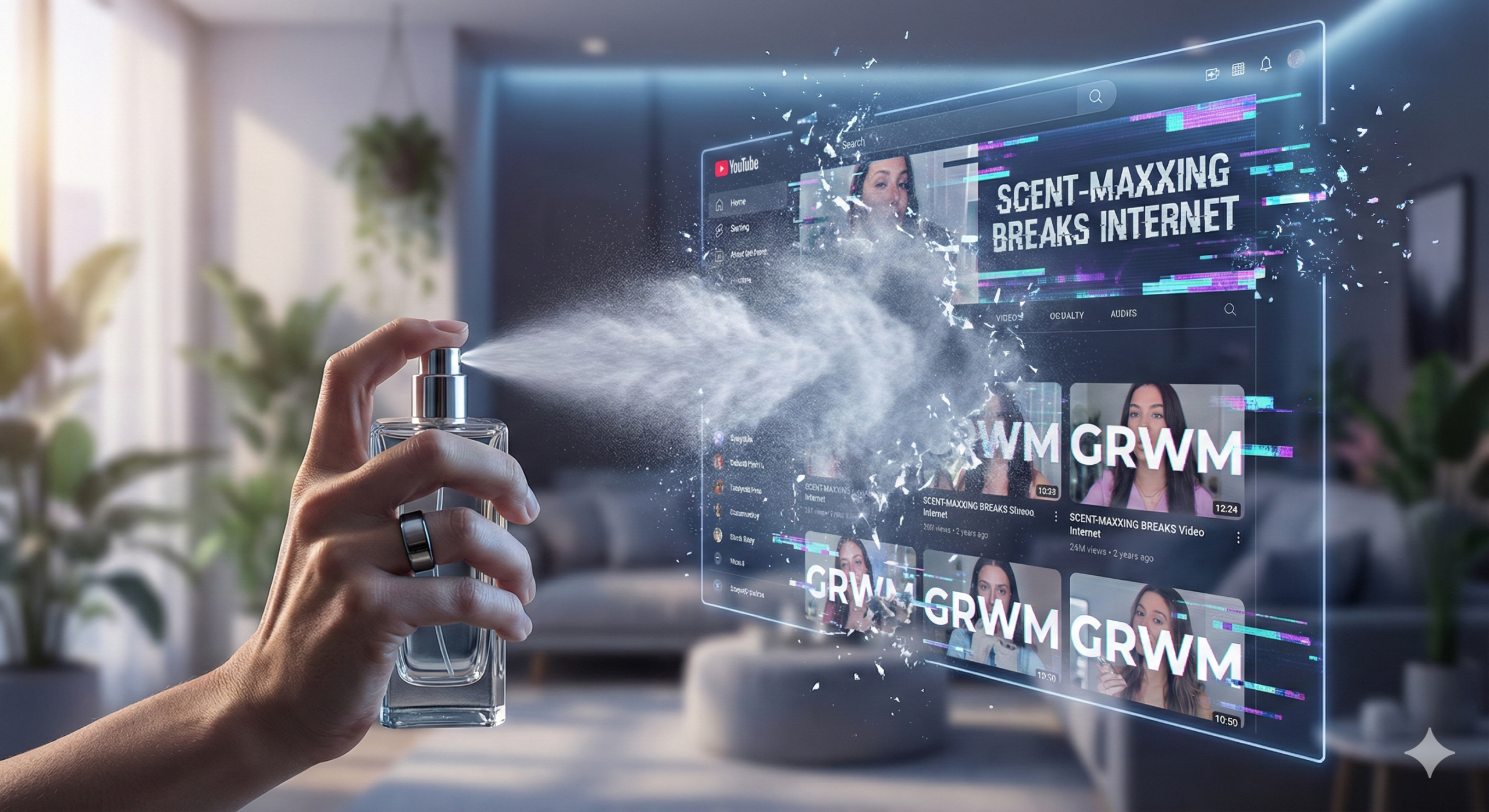

The clock strikes 7:15 AM on a Tuesday in late February 2026. You wake within a room bathed in the soft, artificial glow of smart-tinted windows. Before checking your neural notifications or reaching for your augmented reality glasses, you perform a ritual that has become the defining cultural signal of the mid-2020s.
You aren’t reaching for a makeup palette or a trendy piece of wearable tech. Instead, you stand before a collection of heavy glass vials, performing a precise, almost alchemical routine.
First, you apply a base layer of molecular ambroxan to amplify your natural skin chemistry. Next comes a sharp, metallic “cold flint” extrait that mimics the scent of rain hitting a skyscraper. Finally, you finish with a mist of “toasted pistachio” in your hair to add a touch of creamy warmth.
This isn’t just putting on perfume. This is Scent-Maxxing.
If you’ve spent any time on the “Small Web” or your localized community feeds lately, you’ve witnessed the “GRWM” (Get Ready With Me) videos that have replaced the heavy-contouring tutorials of the early 2020s. Millions of viewers sit in rapt, meditative silence. They watch creators layer five different olfactory products to create a “custom signature” that—ironically—the viewer cannot even smell through the screen.
We have officially reached Visual Peak. In a world defined by 8K resolution, AI-generated hyper-perfection, and infinite digital scrolls, our eyes are exhausted. We are drowning in pixels but starving for molecules. Consequently, the Sensory Revolution has arrived, and the human nose is leading the charge.
I. The Evolution of the Trend: From Subculture to Global Phenomenon
To understand why your social feed is suddenly obsessed with “notes of industrial metal” and “bio-fermented moss,” we must look back at the chaotic digital landscape of 2024.
The term “Smellmaxxing” originally bubbled up from hyper-competitive “looksmaxxing” subcultures on platforms like TikTok and niche Reddit forums. At its inception, the trend was a practical, if slightly aggressive, pursuit of what the community called “beast mode” fragrances. These were scents designed to project power and dominance—the olfactory equivalent of a loud, revving engine.
However, as we moved into 2026, the trend underwent a sophisticated metamorphosis. It shifted from performance (wearing a scent for others) to experience (wearing a scent for personal identity and neuro-regulation).
The “Un-screenshot-able” Status Symbol
Why did Scent-Maxxing “break the internet” when the internet lacks a scent-delivery system? The answer lies in the Digital-Physical Paradox.
In an era where AI effortlessly replicates your voice, your face, and your writing style, your physical scent remains one of the last bastions of authentic, un-hackable human identity. You cannot screenshot a scent. You cannot deep-fake a “scent stack.” To experience someone’s “olfactory aura,” you must be in their physical presence. This reality has turned fragrance into the ultimate luxury: a signal of physical intimacy and “real-world” existence.
By the Numbers: The 2026 Economic Shift
Data from this year’s retail audits is staggering. The fragrance industry is no longer a side-hustle for fashion houses; it is the main event.
- Fine Fragrance Sales: These have seen a 31% year-over-year surge, outpacing traditional color cosmetics for the first time in a decade.
- The “Beast Mode” Demographic: Spending among male consumers aged 16–25 has risen by 26%, with a specific focus on “niche-style” designer scents that offer extreme longevity.
- Format Evolution: Sales of solid perfumes, fragrance primers, and hair mists have grown by 140%, reflecting the shift toward the “Scent Stack” methodology.
II. The Biological “Backdoor”: Why Your Brain is Obsessed
The reason Scent-Maxxing feels so addictive isn’t just clever marketing; it’s hard-wired neurobiology. To understand why certain scents make you feel “productive” or “safe,” we must examine the brain’s internal architecture.
Unlike your senses of sight, hearing, and touch, your olfactory system has a unique “backdoor” into the brain. When you inhale a scent molecule, it bypasses the thalamus—the brain’s central switchboard—and travels directly to the limbic system.
The Limbic System and Emotional Anchoring
The limbic system is the ancient part of the brain responsible for emotion, memory, and the “fight or flight” response. It’s home to the amygdala (the emotion center) and the hippocampus (the memory center).
When a “Scent-Maxxer” layers a specific note of “Old Book Paper” with “Wet Earth,” they are doing more than trying to smell interesting. They are literally hacking their brain. This direct connection explains why a single whiff of a specific perfume can trigger a vivid memory more effectively than a 4K video ever could. It’s an emotional anchor in an increasingly fluid digital world.
The UC Irvine Breakthrough: Cognitive Scent-Maxxing
In a landmark study that has become gospel for 2026 wellness influencers, researchers at the University of California, Irvine, discovered that “targeted scent enrichment” resulted in a 226% improvement in cognitive capacity.
By diffusing different, complex scents during sleep and work, the researchers found that the brain’s neural pathways remained more flexible. This study effectively turned fragrance into a “nootropic.” We now see the rise of Functional Fragrances—scents engineered by neuro-architects to trigger specific brain states:
- Beta-Wave Scents: Sharp citrus, crushed mint, and “metallic ozone” to induce deep work and focus.
- Theta-Wave Scents: Molecular musks and “salty skin” accords to encourage meditation and creative flow.
III. The 2026 “Scent Stack” Masterclass: How to Build Your Aura
If you want to participate in the Sensory Revolution, you must move beyond the “spray and walk” method of the 2010s. The 2026 Scent Stack is a three-dimensional art form. It requires patience, an understanding of chemistry, and a clear vision of your “Identity Note.”
Phase 1: The Molecular Base (The Primer)
Think of this as the “foundation” for your scent. In 2026, we utilize “non-perfume” perfumes built around single molecules like ISO E Super, Ambroxan, or Cetalox.
- The Science: These molecules don’t smell like much in the bottle, but they bond with your skin’s unique pH and pheromones to create a “halo” effect.
- The Goal: You create a canvas that makes everything you put on top last longer and project further without clashing.

Phase 2: The Heart (The Cultural Vibe)
This is where you define your identity for the day. The 2026 market has moved away from the “cloying, sugary” scents of the past. The current obsession? The Mineral Revolution.
- Mineral & Metallic: This is the sound of 2026. Notes include “wet pavement” (geosmin), “cold ink,” “flint,” and “industrial concrete.” These scents feel clean, modern, and slightly detached—perfect for navigating a high-tech urban environment.

- Gourmand 2.0: If you prefer warmth, the new gourmands are “textural” rather than sweet. Trends are leaning toward Pistachio Milk, Toasted Rice, Black Tea, and Cardamom Skins. They smell like a sanctuary, not a candy shop.
Phase 3: The Texture (The Finisher)
A true Scent-Maxxer adds a different format for the final layer to ensure the scent moves with them.
- Hair Mists: Because hair is porous and constantly in motion, it acts as a natural diffuser.
- Solid Perfumes: Applied to warm pulse points, these provide a “close-to-skin” intimacy designed for those you allow into your personal bubble.
IV. The Tech-Scent Paradox: Digital Olfaction and the Future
It is a great irony of 2026: we are using advanced technology to escape the “digital” and return to the “sensory.” However, tech isn’t our enemy; it’s becoming a silent partner in our olfactory obsession.
AI-Driven Discovery & Bio-Matching
The traditional perfume counter—with its confusing strips of paper—is a relic. Today, apps like WhatScent and Aura-Match have revolutionized discovery. By analyzing your heart rate, skin temperature, and Spotify playlists, these AI tools predict which “scent stack” will most effectively regulate your nervous system.
VR & Gaming: The Olfactory Frontier
The Sensory Revolution has finally breached the gaming world. High-end VR setups now include USB-powered scent emitters.
- Immersive Gaming: Imagine playing a survival game set in a forest and actually smelling the damp pine needles.
- The “Scent-Trigger”: In competitive gaming, subtle metallic scents can alert a player to an enemy before they even appear on screen.

V. Conclusion: Reclaiming Your Olfactory Aura
As we navigate the complexities of 2026, the Sensory Revolution serves as a vital reminder: we are biological beings living in a digital world. Scent-Maxxing is more than just a viral trend; it is a search for presence. It is a tactical attempt to anchor ourselves in the “here and now” through the one sense that the internet cannot fully digitize.
In 2026, the most powerful thing you can wear isn’t a designer label or a piece of cutting-edge tech. It is a signature “aura”—a complex, layered, and deeply personal scent that tells the world who you are before you’ve said a single word.
What’s in your 2026 scent stack? Drop your favorite three-layer combination in the comments below!
Leave a Reply