
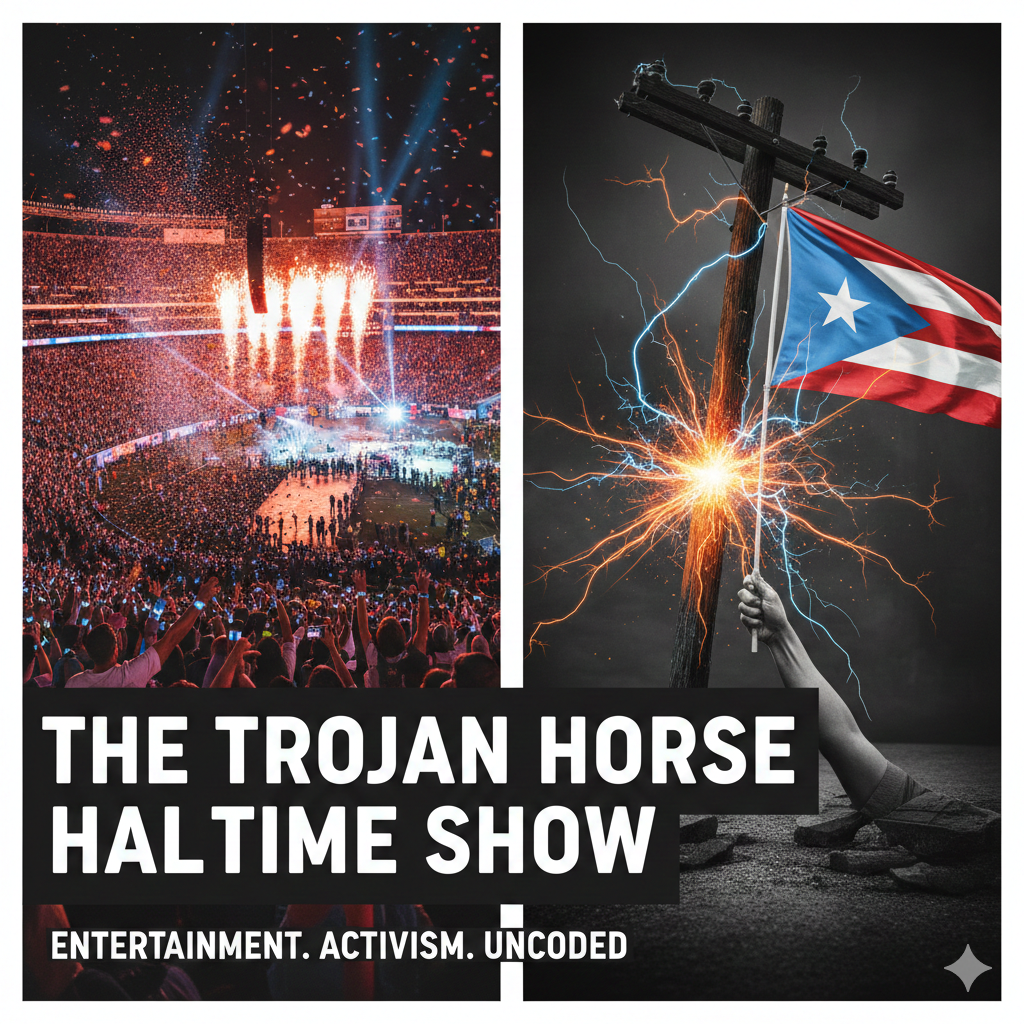
On February 8, 2026, the world tuned in to the Super Bowl for the grit of the gridiron, but they walked away with a cultural manifesto. When Bad Bunny—born Benito Antonio Martínez Ocasio—stepped onto the stage at Levi’s Stadium, he did far more than perform a high-energy medley of global hits. He transformed thirteen minutes of the most expensive airtime in television history into a living, breathing archive of Puerto Rican history, political resistance, and cultural sovereignty.
While the mainstream global audience saw a vibrant, neon-soaked celebration, those familiar with the pulse of Puerto Rico recognized a sophisticated “Trojan Horse.” Benito utilized this massive spectacle to bridge the gap between global pop stardom and local radicalism. In doing so, he brought the struggles of the archipelago—ranging from the sugarcane exploitation of the 19th century to the crumbling electrical infrastructure of 2026—directly into the living rooms of over 128 million viewers.
In this comprehensive analysis, we decode the layers of symbolism that elevated this halftime show from a musical performance to the most politically significant display in NFL history.
I. The Sugarcane Opening: A Visual History of Colonialism
The performance conspicuously avoided the standard opening of pyrotechnics or futuristic CGI. Instead, the cameras panned across a surreal, hyper-realistic stage set dominated by towering stalks of sugarcane. As the atmospheric chords of “Vete” resonated through the stadium, a troupe of dancers emerged from the “fields.” They were dressed as jíbaros—the traditional rural farmers of Puerto Rico—clad in pristine white linen and wearing the iconic pava hats.

The Historical Weight of the Soil
To the casual observer, this may have appeared as a simple tropical aesthetic. To a Puerto Rican, however, it served as a visceral reminder of the island’s economic origin story. Sugarcane functioned as the primary engine of colonial exploitation under both Spanish rule and early American administration. By rooting his performance in these fields, Bad Bunny centered the historical labor, the sweat, and the systemic struggle of the Puerto Rican people. He effectively reminded the world that the “paradise” they visit was built on a foundation of agricultural extraction.
The Paradox of the Pava
The dancers’ straw hats, or pavas, carry a profound dual significance. Historically, the pava represents the dignity and resilience of the mountain-dwelling worker. Politically, the silhouette of the pava serves as the logo for the Popular Democratic Party (PPD). Yet, Benito’s implementation felt less like a partisan endorsement and more like a populist reclamation. He signaled that this stage belonged to the laborers and the common people, deliberately shifting the spotlight away from the elite and toward the island’s authentic cultural backbone.
II. “El Apagón” and the Imagery of Infrastructure Trauma
The energy of the show shifted dramatically as the stadium lights began to flicker and the heavy, industrial bass of “El Apagón” (The Blackout) took over. This segment was far more than a club anthem; it was a rhythmic report from the front lines of Puerto Rico’s ongoing humanitarian crisis.
Infrastructure as a Shared Trauma
During the set, dancers scaled utility poles that sparked and “exploded” in synchronization with the music. For the residents of Puerto Rico in 2026, this was not mere theatricality—it was a representation of their daily reality. Since the catastrophic impact of Hurricane Maria in 2017, the island’s electrical grid, currently under the management of private entities like LUMA Energy, has been defined by chronic instability and record-breaking blackouts.
Reclaiming the Power
By literalizing the “blackout” on the Super Bowl stage, Bad Bunny compelled a global audience to witness the fragility of life on the island. When he shouted the lyrics “Que se vaya la luz!” (Let the light go out!), he was doing more than singing; he was weaponizing the irony of a system that fails to provide basic human needs. This was a public indictment of administrative neglect, celebrated through the lens of a community that has learned to find its own light even in total darkness.

III. The Dual Mystery of the “Ocasio 64” Jersey
One of the most analyzed visual elements of the evening was Bad Bunny’s custom-designed jersey, featuring his maternal surname, Ocasio, and the number 64. This specific detail was a masterclass in multi-layered, strategic storytelling that allowed for both personal mourning and political protest.
The Personal Heritage
Bad Bunny has consistently maintained a close connection to his family roots. In the post-show dialogue, he confirmed that the “64” was an intimate tribute to his late uncle, Cutito Ocasio, who was born in 1964. His uncle was the individual who first introduced a young Benito to the NFL, making the choice of attire a poignant “full-circle” moment performed in the home of the San Francisco 49ers—his uncle’s favorite team.
The Political Rallying Cry
Conversely, within the context of Puerto Rican social activism, the number 64 is a powerful and painful trigger. Following the devastation of Hurricane Maria, the local government and the U.S. federal administration infamously maintained for months that the official death toll was only 64 individuals. This number was eventually debunked by independent university studies, which estimated the true mortality rate to be nearly 3,000.
By wearing “64,” Benito may have utilized a clever “double entendre.” As he would have very much been aware of the symbolism, he honored his family while simultaneously holding a mirror to the world regarding the lives lost to bureaucratic indifference. It was a silent, and evident demand for accountability that bypassed the traditional filters of corporate television.
IV. The Vexillology of Resistance: The Light Blue Flag
Perhaps the most radical act of the night occurred during the finale, involving the flag Bad Bunny chose to wave before millions. While many viewers likely saw the standard Puerto Rican flag, for those steeped in the island’s history of resistance, the specific shade of blue was a revolutionary statement.
Celeste vs. Navy: The Battle of Shades
The flag prominently featured a light blue (celeste) triangle, a choice that carries deep historical weight:
- The Origin: This specific shade was the original 1895 design used by revolutionaries who fought for independence from Spain.
- The Erasure: In 1952, upon the establishment of the “Commonwealth” (Estado Libre Asociado), the government officially darkened the blue to a navy shade to more closely resemble the American flag, symbolizing a political “alignment” with the United States.
An Act of Sovereign Memory
Waving the celeste version of the flag is a widely recognized symbol of the independence movement and a refusal to be assimilated into a colonial identity. By displaying this version on the world’s most prominent commercial stage, Bad Bunny asserted that Puerto Rico possesses an identity that is distinct, sovereign, and defiant. It was an aesthetic act of decolonization.
V. Redefining “America”: The Pan-American Finale
As the performance reached its crescendo, Bad Bunny delivered a moment that ignited immediate debate across social media platforms. Standing at center stage, he addressed the camera and the stadium with a resounding cry: “God Bless America!”
However, the context that followed transformed the phrase from a patriotic trope into a geopolitical critique.

The Continental Perspective
Immediately after the declaration, the massive jumbotron behind him began a rapid-fire sequence of every flag from North, Central, and South America. He began a rhythmic roll call: “Puerto Rico! Dominicana! México! Colombia! Argentina!” This was a calculated challenge to the U.S.-centric definition of “America.” He reminded the audience that “America” is an entire hemisphere, not merely a single nation, and that the millions of Spanish-speaking individuals within and outside U.S. borders are equally “American.”
The Supremacy of Love
The show concluded with a towering graphic: “The only thing more powerful than hate is love.” In the sociopolitical climate of 2026, this was interpreted as a direct rebuttal to anti-immigrant rhetoric. It reframed the “Boricua” takeover of the Super Bowl not as a cultural invasion, but as a celebratory affirmation of a community that refuses to be silenced by marginalization.
VI. Why This Matters: The Evolution of the Artist-Activist
Bad Bunny’s Super Bowl LX performance represents a fundamental shift in how global superstars leverage their platforms. He did not dilute his message for a non-Spanish-speaking audience, nor did he sanitize his political critiques to appease corporate sponsors.
The Power of Authentic Radicalism
Benito proved that it is possible to be the most-streamed artist on the planet while remaining radically local in your concerns. He successfully used the NFL’s massive production budget to construct a set that critiqued the very systems that govern the stadium in which he stood. He didn’t just perform for the world; he invited the world to look at Puerto Rico through his eyes.
The SEO of Cultural Identity
For content creators and journalists, the keywords of this event extend far beyond “reggaetón.” They are accountability, historical memory, and sovereign identity. This performance ensured that for years to come, anyone researching the history of the Puerto Rican flag or the realities of the island’s infrastructure will inevitably find their way back to this thirteen-minute masterclass in visual storytelling.
Conclusion: A Love Letter and a Warning
The Super Bowl LX halftime show was a landmark event that transcended the boundaries of entertainment. It was a love letter to the people of Puerto Rico and a pointed warning to those who would seek to ignore or exploit their resilience. Bad Bunny demonstrated that Puerto Rico is not merely a vacation destination—it is a site of deep historical memory and unyielding cultural joy.
By taking the most American of traditions and making it entirely Boricua, he did more than win the night; he claimed a permanent place in the history of cultural resistance.
Which of these hidden symbols resonated with you the most? Join the conversation in the comments below!
Leave a Reply